
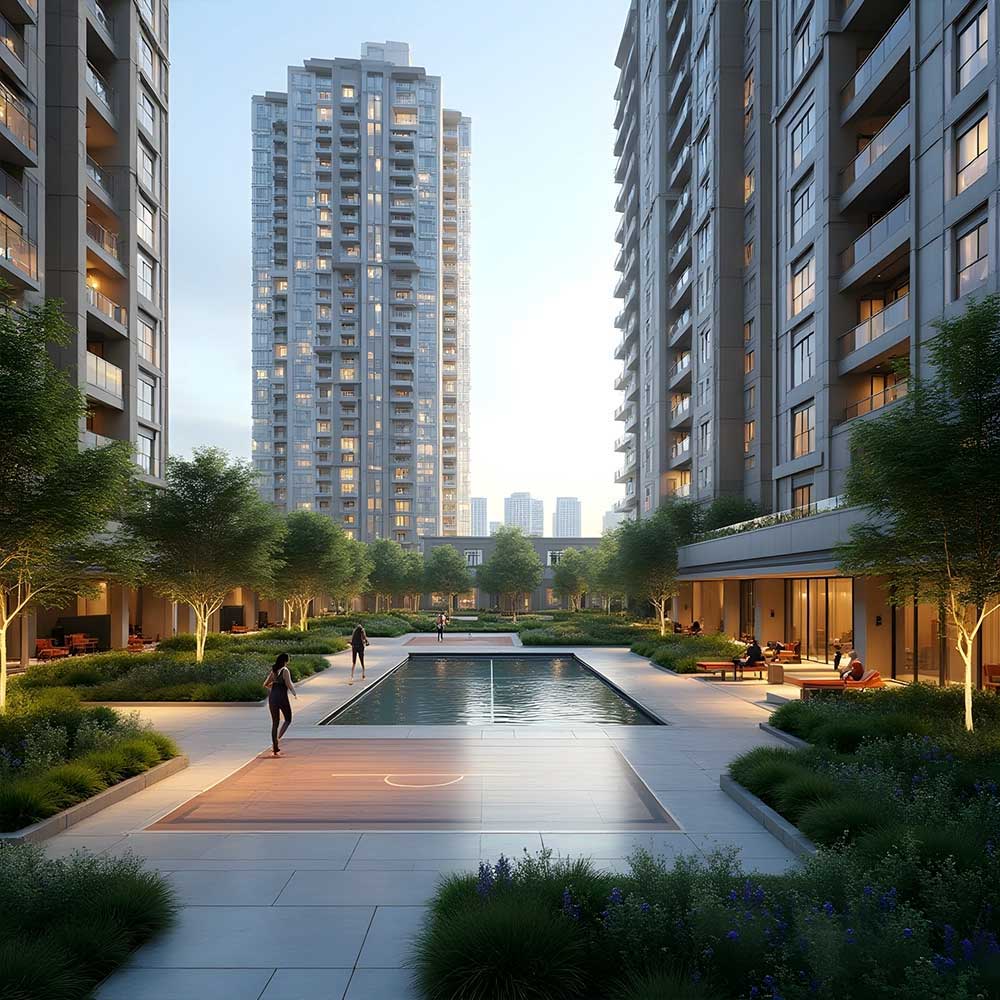
Scroll through Dwarka Expressway project listings and most pitch the same things — amenities, connectivity, pricing. One variable gets mentioned far less often: density. How many homes is a developer actually putting on the land? Ganga Nine Zero, also sold as Ganga Realty Nine Zero, makes density its headline rather than a footnote.
The Density Math
Ganga Nine Zero sits on 4.75 acres and caps itself at three towers (G+32), holding around 240 residences in total. Run that as a rough unit-per-acre figure and it comes out meaningfully lower than many competing Dwarka Expressway launches, which often build more towers or pack more units per floor onto comparable or smaller plots to maximise saleable area. The project also sets aside 80% of its land as open green space rather than additional construction — a ratio most high-density towers in the corridor can't match simply because they've built over more of the plot.
What Low-Density Changes in Practice
Fewer units sharing the same acreage has a few direct, practical effects: less queuing at lifts and amenity spaces during peak hours, more distance between towers (which usually means better natural light and ventilation per unit), and a quieter, less congested common-area experience overall. For families specifically, lower footfall in shared spaces like the clubhouse and gardens tends to matter more day-to-day than it shows up in a brochure.
What Low-Density Doesn't Change
It's worth being precise here — low density is not a substitute for due diligence. It doesn't change a project's RERA status, construction quality, builder track record, or legal title. Ganga Nine Zero still has amenities to evaluate on their own merits (an 80,000 sq. ft. clubhouse with 50+ features), a price to compare against the market, and a RERA registration that is currently awaited. Treat "low-density" as one genuine differentiator among several factors to weigh, not a reason to skip the rest of the checklist.
How to Actually Compare Two Projects on Density
- Ask for the total site area (in acres) and the total number of units planned — then do the per-acre math yourself rather than relying on marketing language like "spacious" or "low-density."
- Check the declared green/open-space percentage, and whether it's landscaped amenity space or just setback margins.
- Compare tower height and units-per-floor — more floors with fewer units per floor is a different trade-off than fewer floors with more units per floor.
- Cross-check the same numbers against the project's RERA filing once registration is complete, since marketing figures and RERA-filed figures can occasionally differ.
Frequently Asked Questions
It means fewer residences built per acre of land. Ganga Nine Zero places around 240 homes on 4.75 acres across three towers — a lower unit-per-acre count than many Dwarka Expressway launches that build more towers or more units per floor on similar or smaller plots.
No — Ganga Nine Zero still offers an 80,000 sq. ft. clubhouse with 50+ amenities. Low-density affects how many residents share those amenities and how much open green space surrounds the towers, not the amenity list itself.
Not necessarily, but lower density usually means the developer is building fewer saleable units on the same land, which can be reflected in pricing. Compare per-sq.-ft. rates and what's included (green cover, amenities, unit mix) rather than headline price alone.
Ganga Nine Zero has three towers (G+32) with around 240 residences on 4.75 acres. Exact tower count and density vary project to project along the Dwarka Expressway, so compare unit counts and site area directly when evaluating alternatives.
It depends on priorities. Low-density projects like Ganga Nine Zero generally offer more privacy, less amenity congestion and more green space; high-density projects can offer more unit choices and sometimes lower entry pricing. Neither is universally better — match the choice to your lifestyle and budget.
- ~240 units on 4.75 acres — a genuinely lower density than most comparable Dwarka Expressway launches.
- 80% green cover is a direct result of that lower density, not a separate feature.
- Low-density is one real differentiator — still verify RERA status, pricing and builder track record independently.